
Is Your Creative Losing the Battle for Attention?
Here’s what I see happening everywhere: marketers investing heavily in targeting and bidding strategies, yet watching engagement rates drop and campaign performance stagnate month after month. Sound familiar? You’re generating impressions, but are you genuinely captivating attention?
Working with top-performing advertisers, one pattern stood out: they treated creative like a living, breathing asset, not a set-it-and-forget-it afterthought. The marketers drowning in data were often the same ones missing one of the most fundamental truths about digital marketing.
Simple: even the most sophisticated ad platforms can’t fix a message that falls flat.
What Google Actually Taught Me About Winning Attention
Let me share something that changed everything for me. The top performers I worked with weren’t obsessing over the newest ad formats or bidding algorithms. The real winners were relentlessly focused on two things: what they were saying and how frequently they evolved that message.
They understood that in 2025, attention has become the new currency. It’s more expensive than clicks. Our audiences are hyper-stimulated, drowning in information, distractions, and fleeting micro-moments. Your challenge isn’t just to be seen, it’s to connect instantly and stay memorable.
Here’s the uncomfortable reality: creative fatigue typically sets in by week 3, yet 67% of marketers fail to refresh their assets monthly. This stagnation quietly erodes campaign performance, costing businesses significant revenue while they’re busy optimizing everything except what matters most.
The Hero’s Journey: Why Ancient Storytelling Still Converts
What do ancient Greek myths, the first Star Wars movie, and your potential customers all have in common? They all connect with the same foundational narrative structure.
It’s the journey of a hero, guided by a mentor who provides a plan to solve their problem. This isn’t marketing theory, it’s how humans have processed information, built trust, and made decisions for millennia.
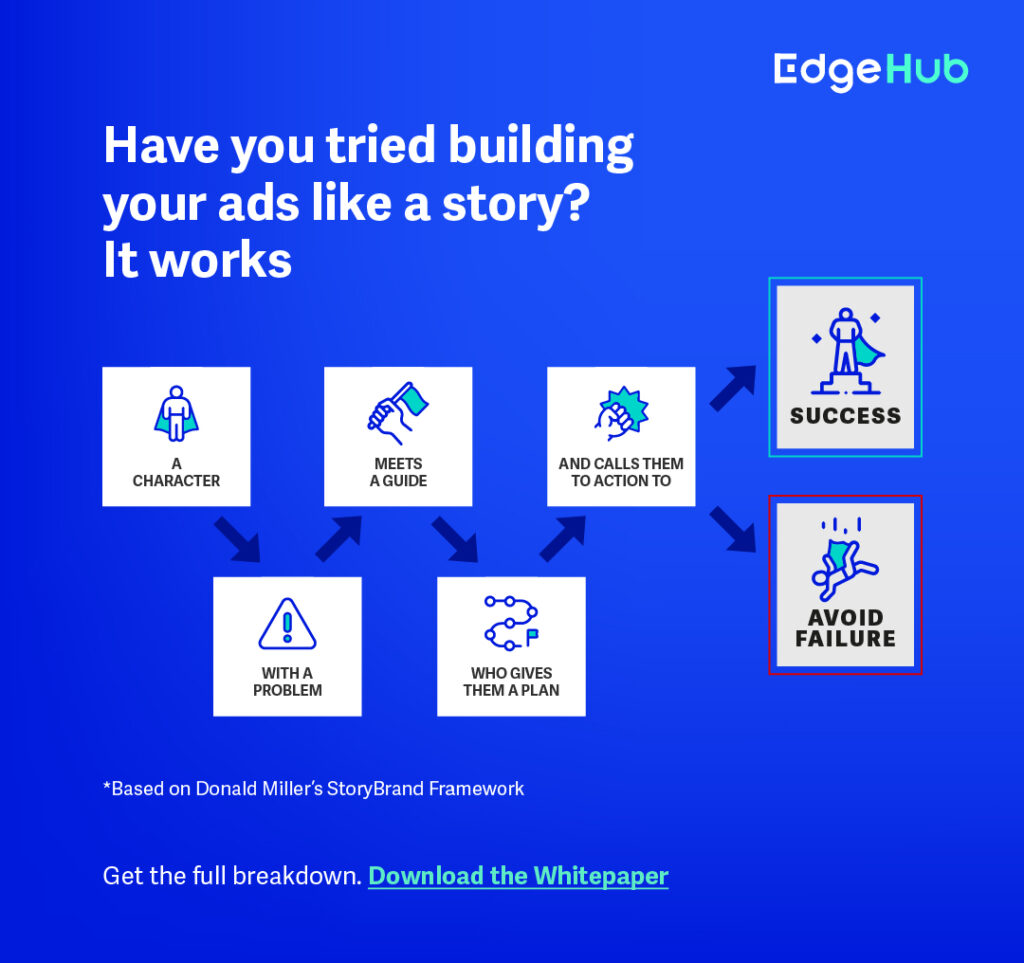
Great creativity doesn’t pitch a product. It positions your customer as the hero, your brand as the guide, and your product as the plan. This is why frameworks like StoryBrand work so powerfully in digital advertising. They force clarity, empathy, and relevance, fast:
- The Customer is the Hero
- The Customer Has a Problem
- The Brand is the Guide
- The Guide Provides a Plan
- The Customer Takes Action
- The Customer Succeeds
Building Your Creative Iteration Engine
The battle for attention means your creativity cannot be a set-it-and-forget-it deliverable. Smart marketers build what I call an “iteration engine”—a systematic process for continuous creative optimization.
Think about it: your hero, your customer, navigates different situations on different days. We must adapt to each moment, delivering the precise message at the exact right time.
Here’s how to build a productive creative tracking system:
- Analyze performance weekly (not monthly)
- Create 3-5 variants per campaign continuously
- Use real user data – clicks, scroll depth, engagement signals
- Refresh images and CTAs regularly – variety prevents fatigue
- Test messaging by funnel stage – awareness vs. decision copy
The numbers confirm this: Creative quality now represents over 56% of campaign performance variance—more than bid strategy or audience targeting combined.
Your Roadmap for Winning Creative in Google Ads
How do you become the guide for your hero? How do you solve their problems with your products while being their trusted mentor, not an exhausting salesperson?
Start with these five actionable strategies:
- Run Creative Sprints
- Build Story-Based Ads
- Customize AI Copy Agents
- Align Messaging to Funnel Stage
- Use Performance Data to Write Creatives
The Creative Edge: Train the AI. Keep the Soul.
You might be thinking that AI tools like ChatGPT, Gemini, or Claude make creative iteration effortless in 2025. But here’s the reality: these tools are powerful amplifiers, not a replacement for strategy.
They should never replace your creative brain — but it can become your fastest-thinking creative partner.
Top marketing teams aren’t just prompting these systems to “write ad copy.” They’re building a dedicated copywriting agent, trained to think and communicate like their brand.
Here’s their playbook:
- Upload your brand’s tone of voice documentation — teach it how you sound
- Feed it your top-performing assets — headlines with the highest CTRs, CTAs that convert, images that stop the scroll
- Load detailed buyer persona insights — real customer pain points, objections, goals, and motivations
- Train it on messaging by funnel stage — awareness hooks, consideration explanations, decision drivers
- Add your FAQs and product differentiators — real inputs, not generic hypotheticals
The result? You get an AI that suggests a copy that sounds authentically like you, understands what already works, and adapts to where each prospect sits in their journey.
Author:
Andres Rodriguez
Head of Marketing Technology