
Do you feel a gap between your marketing efforts and your revenue goals?
Here’s what I used to see every day at Google: marketers drowning in tools, swimming in data, yet somehow still missing their revenue targets. Sound familiar? You’ve got Google Ads running, Meta campaigns live, your CRM is packed with leads… but the numbers at the bottom of your pipeline? They’re not moving.
You’re not alone. During my seven years at Google, I saw this scenario play out again and again, even with the best teams.
Working with advertisers spending millions monthly, the same pattern kept repeating: companies treating each platform like a separate game instead of elements of the same ecosystem. They’d optimize for clicks, celebrate engagement rates, then wonder why revenue stayed flat.
What I Actually Learned Working Inside Google
Let me be honest about something. The biggest budgets didn’t always win. Neither did the fanciest targeting or the newest ad formats. The winners? They grasped something simple that most overlook: marketing is about connecting with people, not just platforms.
Your customers aren’t mere data points. They’re individuals with stories, dreams, fears, and genuine problems seeking solutions. They might be searching Google at 2 AM, unable to sleep due to business worries. They’re comparing solutions during lunch breaks, hoping to find something that actually works.
In this dynamic world of endless platforms and acronyms, the marketers who win stick to what’s always worked: meeting people where they are, with the right message, at the right moment.
How to Map Google Ads Campaigns to Funnel Stages
Think of a disconnected Google Ads strategy as one that treats every prospect the same regardless of where they are in their buying journey. It’s like using the same sales pitch for a window shopper and someone with their credit card ready. The message doesn’t match the moment.
This is where strategic Google Ads funnel mapping changes the game. Instead of running the same approach for everything, you create coordinated ad campaigns that meet customers exactly where they are in their decision-making process. Each touchpoint builds on the last, guiding them naturally toward conversion. You control and guide your narrative to adapt to your buyer’s journey.
With the right approach, your message gains a critical advantage: precision. You decide where, how, and when it arrives, ensuring it reaches and connects with the right person at the exact moment they’re looking for you.
If you’re wondering how to create marketing that actually converts, it’s not about stuffing in more keywords or tactics. It’s about understanding that when someone searches “marketing automation software,” they’re not just looking for features. They’re looking for their Tuesday mornings back. They want to stop manually sending follow-up emails and start focusing on strategy.
That’s the human element no algorithm can replicate.
The Three Pillars That Actually Move Revenue
After countless hours analyzing thousands of accounts, three elements separate top performers from those just ‘getting by’:
- Intent-Driven Messaging: Your ad copy must connect with what people actually want, not what you think they need. This means understanding the nuances behind search queries and speaking directly to their specific situation.
- Data-Driven Optimization: Every click generates data about human behavior. The winners analyze drop-off points, test messages weekly (not monthly), and understand which touchpoints truly drive conversions.
- Real Metrics That Matter: Don’t just celebrate vanity metrics. Focus on Customer Acquisition Cost (CAC), Customer Lifetime Value (CLTV), and actual closed deal value instead of clicks and impressions.
Why Full-Funnel Still Works
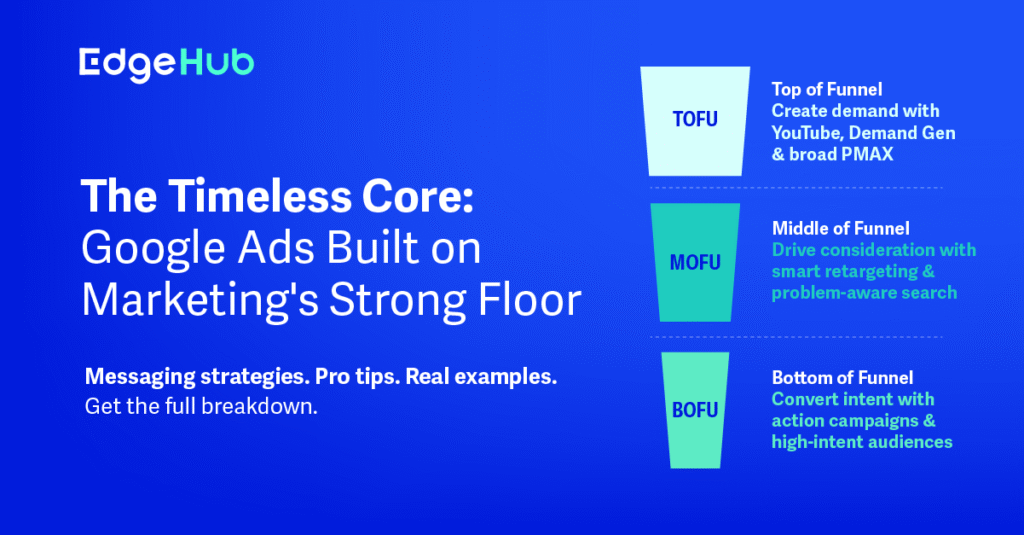
Everyone knows TOFU, MOFU, BOFU. But here’s the uncomfortable truth: very few actually apply it in Google Ads.
The market leaders understand something simple, you need distinct and optimized messages for different stages of the buyer’s journey.
Most marketers run the same campaign for cold traffic and returning customers. That’s like using the same conversation starter with strangers and old friends – it doesn’t work. As we detail in our white paper “7 Learnings from 7 Years at Google Implementing 7-Figure Growth Strategies“, each stage has different goals, audiences to consider, and messaging strategies to work on.
Improving Customer Acquisition Cost with Full-Funnel Marketing
So if you’re still running the same campaign for everything, it’s time to rethink. Stop, take a moment and consider adopting this proven framework immediately.
Here’s what most marketers miss: the specific campaign types, targeting methods, and the correct content strategy to apply for each segment of your funnel. For instance, YouTube Awareness Campaigns work differently than Search Campaigns for middle-funnel prospects. Performance Max requires different creative assets and audience signals depending on whether you’re targeting TOFU or BOFU.
This deeper understanding translates into direct actions. To that end, here are the key strategies you can take to improve your message for your prospects:
- Master Intent-Driven Messaging
- Customize Campaigns by Funnel Stage
- Operationalize Data-Driven Optimization
- Feed the Machine What It Really Needs
- Track Metrics That Reflect Growth – Not Vanity
The data backs this up: according to the Gen Benchmark Report from Google Ads (2024), advertisers using segmented full-funnel strategies saw a 32% lift in qualified lead volume compared to single-campaign approaches.
During my time at Google, I documented these exact campaign mapping frameworks – the specific targeting combinations that work, the creative approaches that convert, and the bidding strategies that optimize for real business outcomes, not just platform metrics.
Our white paper breaks down these detailed campaign mapping examples for each stage, including the specific playbooks that took years to perfect through analyzing thousands of high-performing accounts.
In a world of infinite marketing technology tools, mastering these fundamentals ensures no platform change ever shakes your foundation. Your ideal customer is out there right now, searching for exactly what you offer.
Author: Andres Rodriguez
Performance and Marketing Tecnology Head At Edgehub